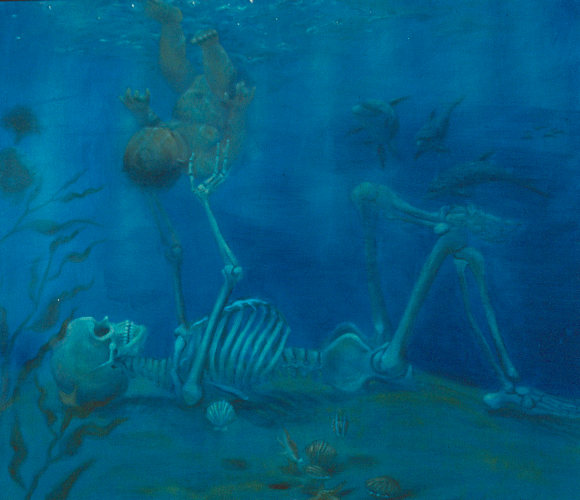
 Face It, Baby #2
1992, acrylic on canvas, 50" x 42"
click images to see enlargement
Face It, Baby #2
1992, acrylic on canvas, 50" x 42"
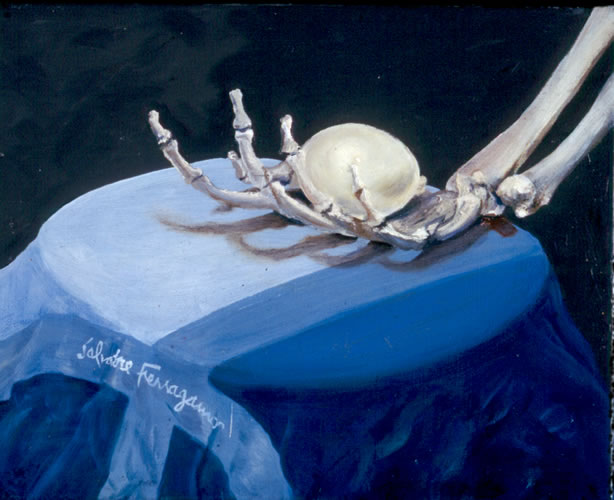 Between (My
Ferragamo scarf)
Between (My
Ferragamo scarf)
1994, oil on canvas, 18" x 20"
 On a Somewhat Less Altruistic Note...
1994-98, mixed media, 5" x 7" each; 13" x 11" each, with frame
(triptych, custom framed)
sold
 Half Dozen
1997, oil on canvas, 3" x 4"
sold
 Egg Study #5
1998, oil on canvas, 4" x 6" oval
sold
 Orchid,
fading #2 (before revision)
Orchid,
fading #2 (before revision)
2003-07, colored pencil, encaustic on birch panel, 12" x 12"
study, nfs
 Untitled
(leaf)
Untitled
(leaf)
2003, colored pencil on ash panel, (4.75 in. x 7 in.)
sold
While still a painting major at the San Francisco Art Institute, I made several surreal, symbolic, surrealistic paintings of human infants and/or skeletons under water. These were not meant to be morbid, nor did I intend them to be disturbing (Face It, Baby).
This archetypal
imagery came to me in the early 1990's, during meditation encounters
with the subconscious, while I was enrolled in a course called "Art,
Spirit, Psyche," with the San Francisco Art Institute. It was very
much like watching an old, monochromatic, World War II newsreel:
while still awake, but with my eyes closed, I clearly saw a living
infant (no, not a fetus), floating quite calmly in some sort of
liquid; the child moved its limbs quite freely, so it was not
amniotic fluid but some large body of water. The baby was clearly
not drowned. It was alive and comfortable in this element.
When I was painting my first impression from this vision, a stranger came up to watch me, as I worked in one of the S.F.A.I. studios. He stood there for some time.
"You obviously don't have kids,
do you?" he finally asked me. "No, I don't," I replied, turning to him with a
smile. His jaw clenched. "I didn't THINK so!" he huffed, storming
out of the studio. I can only imagine that the poor fellow must have
thought I was callously painting a drowning or drowned baby. (And,
to be fair, there was quite a lot of morbid student artwork
on display then; dismembered figures were particularly popular at
the time.)
Years later, while researching Celtic stories for my
current work, I found a reference to Taliesin as a "child emerging from
the sea." Later, I read of other cultures which also feature a water
baby or hero. Perhaps my subconscious had tapped into that. I have been present at a few births, as well as deaths, so I
do know firsthand that these significant moments of entry and exit to
and from this world are often deeply profound, or even sacred.
The Latin American cultures in San Francisco's Mission
district, where I lived, were also an influence on my imagery. Mexico's Dios de Los Muertos, or Day of
the Dead, celebrated annually on November 2, follows on the heels of All
Saint's Day and All Hallow's Eve (what we now call Hallowe'en). While
painting my early works, the immortal triad of human existence (Time,
Love, and Death) would frequently surface, often reflecting traditional
Mexican Vanitas (Between (My
Feragamo scarf ) and Cupid,
Being Stupid). Whether
we are viewing a portrait, a still life, a landscape, or an abstract
image, it may be permeated with potential and/or loss, as the painter,
Mark Rothko, conveyed through his
abstract works.
A tiny mixed-media triptych, using photographs I took of
Fred, my plastic skeleton model, lying in the snow near Lake Tahoe (On A Somewhat Less Altruistic Note...)
and the Cupid paintings, were originally inspired by a sequence of
events I'd experienced on Dios de Los Muertos.
But the child of Venus and Mars is NOT a cherub, and
is definitely not any sort of of angel. I suspect Christianity, and the
commercialization of St. Valentine's Day, both did Cupid a kind of
disservice, if not entirely undeserved (see Cupids).
Many classical paintings feature cute little Putti, which are
depicted as, chubby,
lily-white toddlers; they're sometimes confusingly mis-labelled as
cupids (more about all this by Jonathan Kurtzman and Doug Newsom in Quora).
I feel that the tale of Cupid and Psyche was made most personal and clear in the timeless work, Till We Have Faces, by C.S. Lewis.

