(The following information was taken – without permission – from http://www.gallica.co.uk/celts/calendar.htm)
"The Celts counted the days as starting at sun down and longer periods as
'x'(a number)-nights, and months were moons. This still hangs over into
present use with two weeks expressed as a fortnight (fourteen nights, or
half a moon). Up until Georgian times a week was expressed as a sennight
(seven nights). Festivals were on the nearest moon, new or full depending
on the festival. The length of the moon cycle is 28 and a bit days. This
gives 12 moons in a normal Solar year. Every 21 years there are 13 moons
in the year and this is called a Great Lunar Year. The last one was 1993
so the next is 2014.
[AUTUMN]
The Celtic year was divided into four main parts based on the farming
cycle, starting the New Year with the festival of SAMHAIN,
when the world starts to darken into winter. The veil between the human
world and the world of the dead becomes very thin. This gives you the
opportunity to invite your ancestors over the veil to join in the feast.
The following day in the calendar has no name, this is to stop the spirits
from being trapped in our world, and to make the journey back over the
veil much easier. The modern date for this is 31 October, and goes a long
way to explaining the depiction of the ghosts and ghouls at Halloween (All
Hallows Eve). The Christian church was unable to stop this festival, so
they tacked on All Souls Day, and All Saints Day, to try to counter the
effects following Halloween.
[WINTER]
The end of winter and the start of the awakening of the world is marked
by IMBOLC, which translated from the Celtic
languages is 'the lactation of the ewes'. The birth of the first lamb
means that there is once again fresh milk available, and the proof of new
life returning. The modern date for this is 2 February, which in the
Christian calendar is Candle-mass.
[SPRING]
The most lively festival of all is BELTAIN,
the first day of summer. It was marked by the appearance of the first May
blossom. A time of partnerships and fertility. New couples would proclaim
their love for each other on this day. Writings from the puritanical
elements during the English civil war show the festival was alive and well
in the 17th century. We have quotes such as- "Couples would go into the
woods at night and ne'er a third returned undefiled!"
Animals were transferred from winter to summer pastures, and were driven
between the Beltain fires to cleanse them of evil spirits.
In the present however, the festival has been high-jacked by the left wing
of politics and May 1st was declared a national holiday in many countries.
(The Christians have no equivalent date at this time of year!)
[SUMMER]
The last major festival is the bringing in of the harvest, starting on
the feast of LUGNASA. The festival lasts for
a whole moon and was a celebration of the Gods providing all that was
needed. The Culmination of the festival is Harvest Home. This is the last
load coming in from the fields, and the capturing of the goddess of the
cereal. The hang-over from this is the making of a 'corn dolly',
originally in the shape of a woman. This was the home of the goddess over
the winter and was put back into the ground in the first furrow of the
plough in the spring.
Mixed through the middle of the farming year is the Solar year with the
Solstices and Equinoxes. Although these dates are associated more with the
Druids - and that is a whole subject on its own.
The festival of Oester is for the Spring Goddess. It is celebrated on the
first full moon after the spring equinox ( which is at 01:45 am, 21
March), the date of the festival this year being 31 March, at 22:50 pm.
Times are GMT.
The Spring Goddess is represented by the hare, because of the mating
rituals, and the egg, symbol for new life.
The Christians took the festival and put it on the next Sunday. The name
has corrupted to Easter, and the hare has given way to the rabbit! - But -
eggs are still exchanged, continuing the old custom."
See The White Roebuck
, Reduction
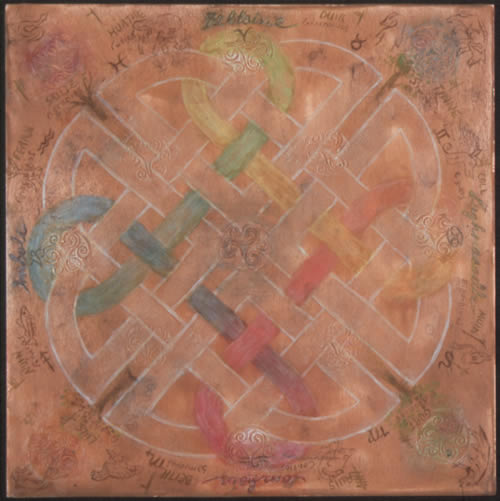
(Recognition-a self portrait), and Celtic
Knot #1